
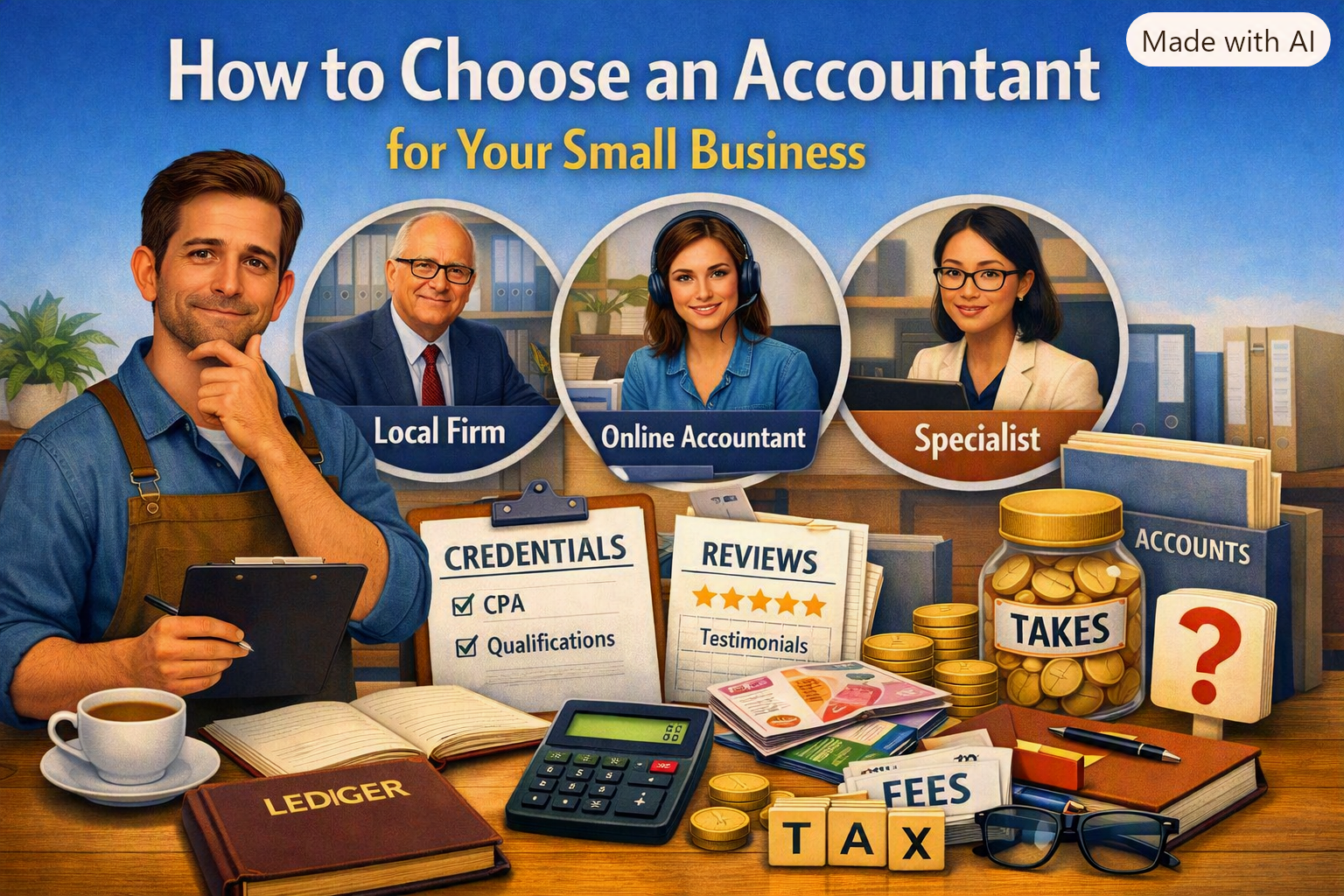
How to Choose an Accountant for Your Small Business
Anyone can call themselves an accountant in the UK; the title itself isn’t legally protected, unlike “solicitor” or “chartered surveyor”. That makes choosing one even more important than it might seem. Here’s what qualifications actually mean, what different accountants cost, and the questions worth asking before you commit.
Do you need an accountant at all?
Not every business does, at least not for everything. A sole trader with straightforward income, modest turnover, and no employees can often manage bookkeeping and even self-assessment filing without paid help, particularly using decent cloud accounting software; see our bookkeeping basics guide for what a workable system looks like.
An accountant becomes genuinely valuable once things get more complicated: you’re running a limited company, you have employees and need payroll handled correctly, you’re VAT registered, your income is near a tax threshold where planning matters, or you simply don’t have the time or inclination to keep on top of changing rules.
Many business owners also use an accountant simply for peace of mind — knowing a professional has checked the numbers before they go to HMRC.
What the qualifications mean
Because “accountant” isn’t a protected title, anyone can set up and offer accountancy services with no formal training at all. Qualifications are the main signal of competence and accountability, and the main bodies you’ll encounter are:
Institute of Chartered Accountants in England and Wales. A rigorous qualification with an audit-focused background, common among practices handling larger or more complex businesses.
A globally recognised chartered qualification, very common among small and medium practice accountants serving small businesses directly.
Focused on management and business accounting rather than external reporting — often found in-house rather than in general practice.
Specialist tax qualifications. Worth looking for if your query is specifically about tax planning rather than general bookkeeping and accounts.
A qualified accountant will be a member of one of these (or a similar) professional body, which means they carry professional indemnity insurance, follow a code of ethics, and are subject to a complaints and disciplinary process if things go wrong.
An unqualified “accountant” may still be competent and reasonably priced, but you lose that layer of protection.
What accountants typically charge
Fees vary considerably by region, firm size, and complexity, but rough benchmarks for straightforward small business work are:
| Service | Typical cost |
|---|---|
| Sole trader self-assessment return (straightforward) | £150–£400 |
| Ongoing bookkeeping and accounts support (sole trader, monthly) | £25–£150/month |
| Limited company annual accounts and corporation tax return | £800–£2,000+ |
| Monthly payroll (small team) | £5–£10 per payslip, often with a minimum monthly fee |
| VAT return preparation and filing | £50–£150 per quarter |
Many small business accountants now offer fixed monthly packages bundling bookkeeping software, annual accounts, tax returns, and general advice, rather than charging by the hour or per task.
This gives you cost certainty and tends to encourage you to ask questions throughout the year rather than save everything up (and rack up fees) for one annual conversation.
Questions to ask before you sign up
- Are you regulated, and by whom? Ask which professional body they belong to and their membership number.
- Do you have professional indemnity insurance? A qualified accountant should have this as standard.
- What’s included in your fee, and what’s extra? Get clarity on whether bookkeeping software, phone support, and ad hoc questions are included or billed separately.
- Do you have experience with businesses like mine? Industry-specific knowledge — construction, hospitality, e-commerce — can materially affect the quality of advice you get.
- How do we communicate, and how quickly do you respond? Some firms are excellent on annual compliance but slow to answer a quick question mid-year.
- What software do you use, and is it included? Cloud accounting software is now central to how most small accountancy practices operate.
- Can you help with growth, not just compliance? Some accountants are purely compliance-focused; others offer genuine business advice on cash flow, pricing, and planning.
Red flags to watch for
A legitimate accountant will happily confirm their professional body and membership number — hesitation here is a genuine warning sign.
Aggressive claims about minimising your tax bill, especially before they’ve seen your actual figures, can signal an appetite for schemes HMRC is likely to challenge.
This protects you if their advice causes you financial loss — an accountant without it is a significant risk.
You should be able to get a clear indication of cost before you commit, not a vague promise to “sort out a fee later”.
Late filings are ultimately your legal responsibility, not your accountant’s — a pattern of missed deadlines is a reason to move on, not just a minor inconvenience.
Switching accountants
Switching is more straightforward than many business owners assume.
Once you’ve chosen a new accountant, they’ll typically send a professional clearance letter to your existing one requesting relevant information and confirming there’s no reason (such as unpaid fees or a dispute) preventing the handover.
Your new accountant handles most of this process for you.
Good times to switch include after your annual accounts have just been filed (a clean break at the start of a new accounting period), or when your business has genuinely outgrown what your current accountant offers, moving from sole trader to limited company, for instance, or needing specialist advice they don’t provide.
Common mistakes
Without checking qualifications or regulation, and ending up with advice you can’t rely on if it goes wrong.
Then being surprised by charges for phone calls, emails, or “quick questions” throughout the year.
Even after service or responsiveness has declined.
When many expect you to arrive with organised records rather than a shoebox of receipts.
Which limits your choice to whoever has capacity rather than who’s the best fit.
Useful resources
- ICAEW Find a Chartered Accountant — icaew.com/regulation/find-a-chartered-accountant
- ACCA member and firm search — acca.global
- Our bookkeeping basics guide — setting up a system that doesn’t fall apart
- Our self-assessment guide for sole traders — everything you need to know about filing your return
More guides for UK small business owners
Right Hand Man covers everything from self-assessment and VAT to hiring your first employee and business bank accounts. Browse our guides or get in touch if you have a question.