
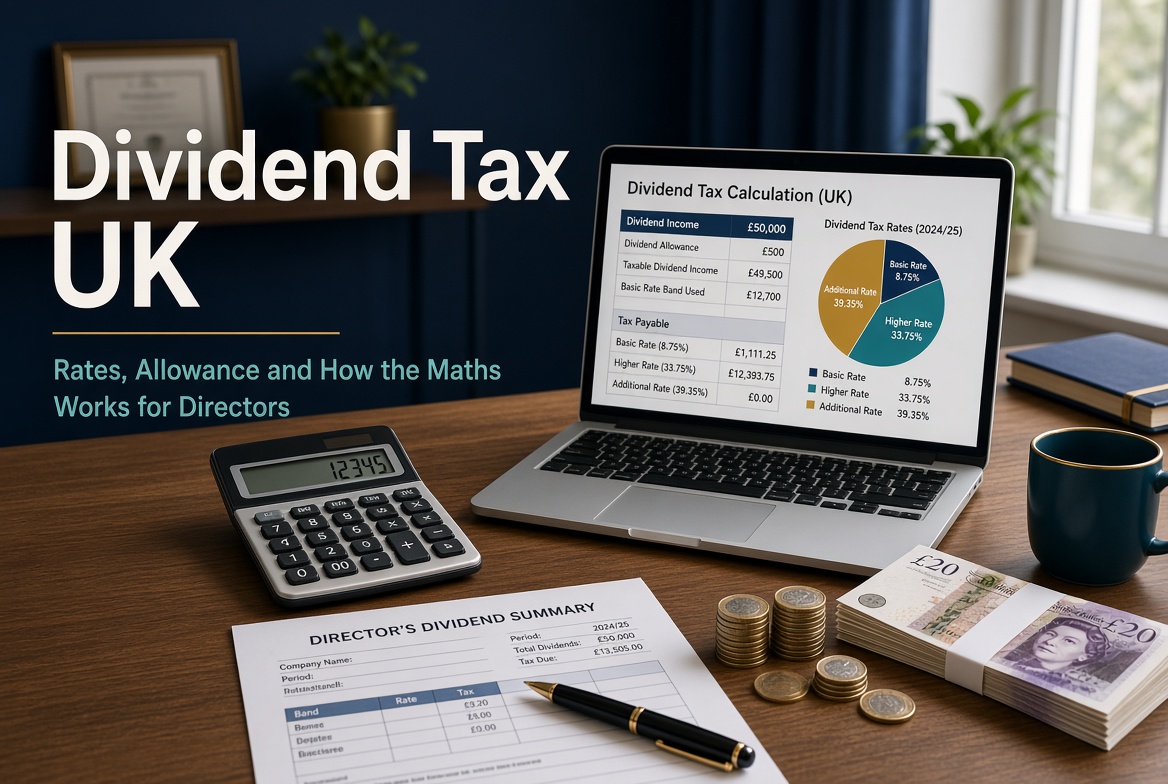
Dividend Tax: A Guide for Limited Company Directors
If you run your own limited company, how you take money out of it matters almost as much as how much you take. Dividend tax rates rose again in April 2026 — here’s what dividends are, the current rates and allowance, and how the maths actually works.
What a dividend is
A dividend is a payment a limited company makes to its shareholders out of profits that remain after corporation tax has already been paid. This is the fundamental difference between a dividend and a salary: salary is a business expense, deducted before corporation tax is calculated; a dividend is a distribution of profit that’s already been taxed at company level, then taxed again personally when it reaches the shareholder.
Because dividends come from post-tax profit, they can only be paid if the company actually has distributable profits available — more on this in paying dividends correctly.
Why directors use salary and dividends together
For director-shareholders of their own limited company, a combination of a modest salary and dividends is a common way to extract income, for two main reasons:
- National Insurance: dividends don’t attract employee or employer National Insurance contributions, unlike salary above the relevant thresholds. A small salary can still be worth paying, since it counts towards your State Pension entitlement and can be structured to fall within employer NIC allowances.
- Lower headline rates: dividend tax rates are lower than equivalent Income Tax rates at every band — 10.75% versus 20% at basic rate, for example — though this comparison only tells half the story, since corporation tax has already been paid on the profit before it’s distributed as a dividend.
Dividend tax rates and the dividend allowance
Everyone has a dividend allowance, separate from their Income Tax personal allowance, meaning the first slice of dividend income each year is tax-free regardless of your other income.
| Band | 2025/26 rate | 2026/27 rate |
|---|---|---|
| Dividend allowance | £500 (0%) | £500 (0%) |
| Basic rate | 8.75% | 10.75% |
| Higher rate | 33.75% | 35.75% |
| Additional rate | 39.35% | 39.35% |
The basic and higher rates both rose by 2 percentage points from 6 April 2026, confirmed at the Autumn 2025 Budget. The additional rate and the £500 allowance are unchanged. The allowance itself has fallen sharply over the years — it was £5,000 as recently as 2017/18 — so the tax-free element of taking dividends is considerably smaller than it used to be.
How dividend tax is calculated
Dividend income is treated as sitting on top of your other income — salary, pension, rental income, savings — when working out which tax band it falls into. Your salary and other income use up the lower bands first; dividends then stack on top and are taxed at whichever rate applies to that portion of your total income.
Example: a director takes a salary of £12,570 (using up the full personal allowance) and £60,000 in dividends, with no other income.
- The £500 dividend allowance covers the first slice, tax-free
- The next £37,200 of dividends falls within the basic rate band and is taxed at 10.75% — £3,999
- The remaining £22,300 falls within the higher rate band and is taxed at 35.75% — £7,972.25
- Total dividend tax: £11,971.25
This is a simplified example for illustration — your actual calculation depends on your specific salary, any other income, and your personal allowance, which tapers away entirely once total income exceeds £125,140.
Paying dividends correctly
Dividends can only be paid from distributable profits — retained profit after corporation tax, not simply whatever cash sits in the business bank account. Paying a dividend the company can’t actually support out of its profits is known as an illegal or unlawful dividend, and can be reclassified by HMRC as a loan or even salary, with different (often worse) tax consequences, on top of the original problem of having taken money the company didn’t have.
A proper process for each dividend payment includes:
- Board minutes: a record that the directors formally declared the dividend
- Dividend vouchers: issued to each shareholder, showing the amount and date
- Checking distributable reserves first: confirming the company’s profit and loss account shows sufficient retained profit before declaring the dividend
This is another area where an accountant earns their fee — checking distributable reserves properly, particularly for a company with fluctuating profits, isn’t always straightforward from the numbers alone.
Reporting dividends to HMRC
You need to report dividend income through Self Assessment if your dividends exceed both your unused personal allowance and the £500 dividend allowance. For most director-shareholders taking a meaningful dividend income, this means registering for Self Assessment and filing a return each year, even if you’re also taxed through PAYE on a salary from the same company.
See our self-assessment guide for the registration process and filing deadlines if you’re not already registered.
Common mistakes
Risking an unlawful dividend if the company hasn’t actually made the retained profit to support it.
Leaving no paper trail if HMRC ever queries the payment.
Even when tax is also being paid through PAYE on a salary.
Rather than understanding it’s taxed at 0% within your existing band.
Without accounting for your own personal allowance use, other income, and company profit levels.
Useful resources
- HMRC guidance on tax on dividends — gov.uk/tax-on-dividends
- HMRC guidance on distributions and dividends — gov.uk/hmrc-internal-manuals/company-taxation-manual
- Our corporation tax guide — rates, marginal relief, and deadlines
- Our guide to choosing an accountant — qualifications, costs, and questions to ask
- Our self-assessment guide for sole traders — everything you need to know about filing your return
More guides for UK small business owners
Right Hand Man covers everything from corporation tax and VAT to hiring your first employee and choosing an accountant. Browse our guides or get in touch if you have a question.