
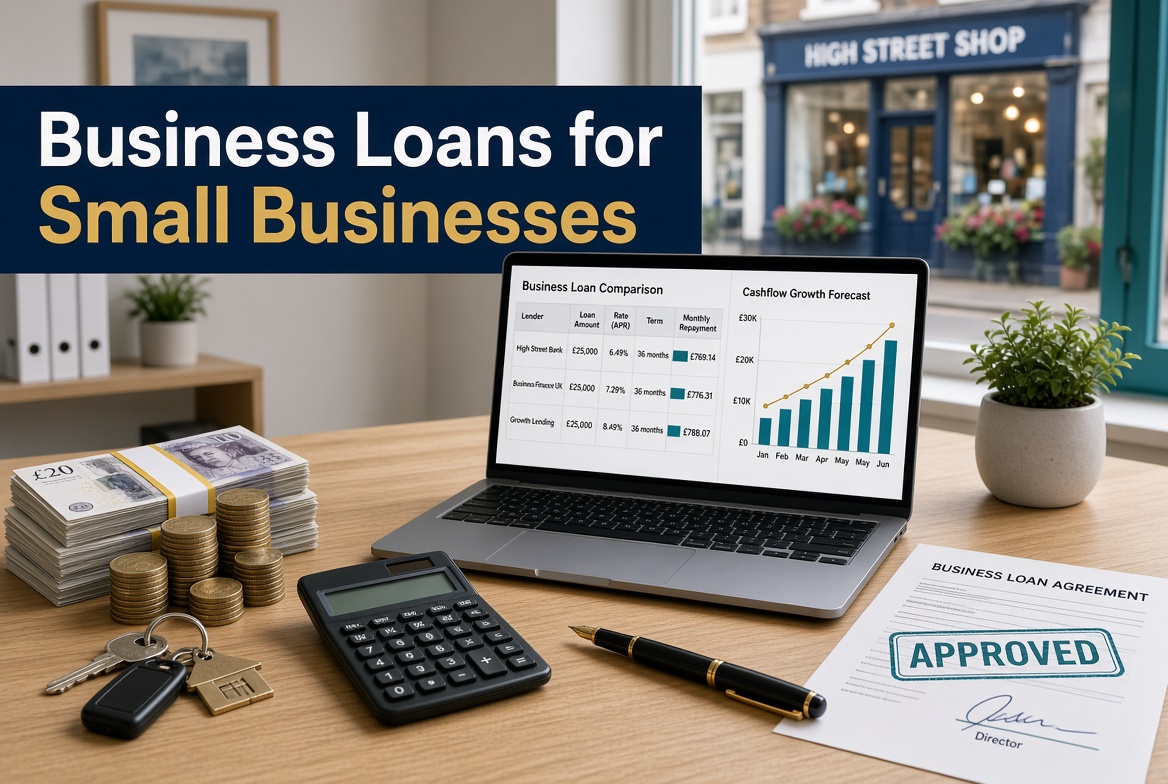
Business Loans for Small Businesses
Whether you’re covering a cash flow gap, buying equipment, or funding genuine growth, at some point most small businesses consider borrowing. Here’s a guide to the main types of business finance available, what lenders actually look for, and how to work out which option fits your situation.
Types of business finance
A lump sum repaid with interest over an agreed period, typically one to ten years. The most familiar form of business borrowing, suited to a defined purpose — buying equipment, funding expansion, or consolidating other debt.
A flexible line of credit attached to your business account, drawn down and repaid as needed. Useful for smoothing short-term cash flow gaps rather than funding a specific one-off purchase.
Borrowing secured against a specific asset — vehicles, machinery, equipment — either to fund a new purchase (hire purchase) or to release cash tied up in assets you already own (asset refinance).
Borrowing against unpaid customer invoices, releasing a percentage of the invoice value immediately rather than waiting the full payment term. Particularly useful for businesses with long payment cycles.
An advance repaid as a percentage of future card sales, common in retail and hospitality. Fast to arrange but typically among the more expensive forms of finance available.
Loans where the government guarantees a portion to the lender, making finance accessible to businesses that might not otherwise qualify — see the Growth Guarantee Scheme below and our separate Start Up Loans guide.
The Growth Guarantee Scheme
The Growth Guarantee Scheme is the government’s main current guarantee scheme for smaller businesses, delivered through the British Business Bank and a panel of accredited lenders rather than directly by government. It replaced the Recovery Loan Scheme in 2024 and has since been extended until 31 March 2029.
Key features:
- Maximum facility: up to £2 million per business group
- Products covered: term loans, overdrafts, asset finance, invoice finance, and asset-based lending — not every lender offers every product
- Eligibility: businesses with annual turnover up to £54 million, following a recent increase from £45 million
- Term length: up to 10 years for larger term loans and asset finance facilities, extended from the previous 6-year maximum, with shorter terms available for overdrafts and invoice finance
The scheme works by the government guaranteeing 70% of the lender’s loss on each facility, which encourages lenders to offer finance to viable businesses that might otherwise struggle to get approved — but you remain fully liable for repaying the loan yourself; the guarantee applies to the lender, not to you.
What lenders look for
Regardless of the type of finance, most lenders assess similar factors:
- Trading history: most lenders want to see at least 12–24 months of trading, though some products (including Start Up Loans) are designed for younger businesses.
- Cash flow and affordability: whether your business generates enough consistent income to comfortably service the repayments, not just whether you can technically afford them in a good month.
- Credit history: both your personal credit history as a director and your business’s credit file, where one exists.
- A clear purpose: lenders generally want to understand specifically what the finance is for and how it supports the business, rather than a vague request for working capital.
- Management accounts and forecasts: recent accounts, bank statements, and cash flow forecasts to support the application — see our bookkeeping basics guide for keeping these in good order year-round rather than assembling them under pressure.
Secured vs unsecured borrowing
Secured borrowing is backed by a specific asset — property, equipment, or a personal guarantee from a director — which the lender can claim if you default. It typically comes with lower interest rates and higher borrowing limits, reflecting the reduced risk to the lender, but puts the secured asset genuinely at risk.
Unsecured borrowing doesn’t require specific collateral, though many lenders still require a personal guarantee from a director for small-business lending, particularly for newer or smaller companies. Rates are typically higher and borrowing limits lower than secured equivalents, reflecting the greater risk the lender is taking on.
Typical costs
Interest rates vary considerably depending on the lender, the type of finance, whether it’s secured, and your business’s individual risk profile, so there’s no single “typical” rate that applies across the board. As a general pattern:
- Secured term loans and asset finance tend to sit at the lower end of the market
- Unsecured term loans and business credit cards sit higher
- Merchant cash advances and short-term unsecured lending are typically the most expensive per pound borrowed
Always compare the total cost of borrowing — including arrangement fees, early repayment charges, and any ongoing account fees — rather than the headline interest rate alone. A lower rate with high fees can end up costing more than a higher rate with none.
How to apply
- Work out exactly what you need and why, including the amount, the purpose, and how you’ll repay it, before approaching any lender.
- Gather your paperwork: recent accounts or management accounts, bank statements, a cash flow forecast, and details of any existing borrowing.
- Check eligibility for guarantee schemes first, since these can offer better terms than standard commercial lending for eligible businesses.
- Compare more than one lender, ideally through a broker or your accountant’s network if you don’t have existing relationships with several banks.
- Read the full terms before signing, particularly around personal guarantees, early repayment charges, and what happens if you miss a payment.
Common mistakes
For how the money will be used and repaid, rather than treating finance as a general safety net.
Missing fees and charges that materially change the total cost.
Potentially missing better terms than standard commercial finance.
Treating it as a formality rather than genuine personal liability.
Rather than comparing terms across several options for the same borrowing need.
Useful resources
- British Business Bank — Growth Guarantee Scheme — british-business-bank.co.uk/growth-guarantee-scheme
- Our Start Up Loans guide — a government-backed option for younger businesses
- Our bookkeeping basics guide — keeping records lenders will want to see
- Our cash flow management guide — spotting a funding gap before it becomes a crisis
More guides for UK small business owners
Right Hand Man covers everything from business bank accounts and bookkeeping to hiring your first employee and choosing an accountant. Browse our guides or get in touch if you have a question.